APIs have become the backbone of modern digital ecosystems. They're what connect mobile apps to cloud services, power financial transactions, and enable everything from e-commerce to IoT. But as organizations rely more heavily on APIs, attackers do too and the uncomfortable truth is this:
Many API attacks slip through firewalls without raising any alarms.
Even when the firewall is properly configured.
This article explains why that happens, what the research shows, real-world examples of API breaches, and finally how RitAPI is built to stop exactly the types of attacks that firewalls miss.
Why Firewalls Struggle to Protect APIs
1. API Traffic Looks Legitimate
Most API communication uses:
- HTTPS
- encrypted payloads
- predictable request patterns
To a firewall, it’s just “normal traffic.”
But attackers often wrap their attacks inside perfectly valid requests. Nothing looks unusual at the network level.
2. API Attacks Target Business Logic
Traditional firewalls rely on signatures and static rules.
But API attacks often exploit:
- logic flaws
- broken authorization
- valid parameter manipulation
These are not “signature-based” attacks they exploit how the API actually works.
3. APIs Have Dozens Sometimes Hundreds of Endpoints
Firewalls see patterns.
They do not understand:
- what each endpoint does
- which parameters are allowed
- how data should behave
As a result, malicious requests often pass through unchallenged.
What the Research Says
Industry data consistently shows how vulnerable APIs are:
- Salt Security: 74% of API attacks were not detected by firewalls.
- Cloudflare: Huge growth in API scraping & credential abuse that firewalls failed to stop.
- OWASP API Security: Most API risks stem from logic flaws, not network-level threats.
In short: firewalls protect the perimeter, not the logic inside your API.
Real Incidents: API Attacks That Walked Right Past Firewalls
1. Fintech Provider — Transaction Data Leak
A fintech company exposed private transaction history because an endpoint only checked for a token’s existence not whether the token belonged to the resource owner.
The firewall accepted the request as valid HTTPS traffic.
The API logic was the problem.
2. E-Commerce Platform — Massive Product Scraping
Attackers iterated through product IDs and extracted the entire catalog.
To the firewall, it looked like:
- normal GET requests
- repeatedly hitting a legitimate endpoint
But behind the scenes, the attacker harvested all pricing and inventory data.
3. Ride-Hailing App — Fare Manipulation
A ride-hailing service allowed users to modify parameters such as distance or route inside the JSON body.
The requests were well-formed, so the firewall allowed them.
But attackers figured out they could lower their fare with a simple parameter tweak.
How These Attacks Slip Through
Because firewalls do not:
- validate API schema
- understand parameter relationships
- enforce resource-level authorization
- analyze user or token behavior
They simply aren’t built for API business logic security.
RitAPI: Purpose-Built Protection Where Firewalls Fail
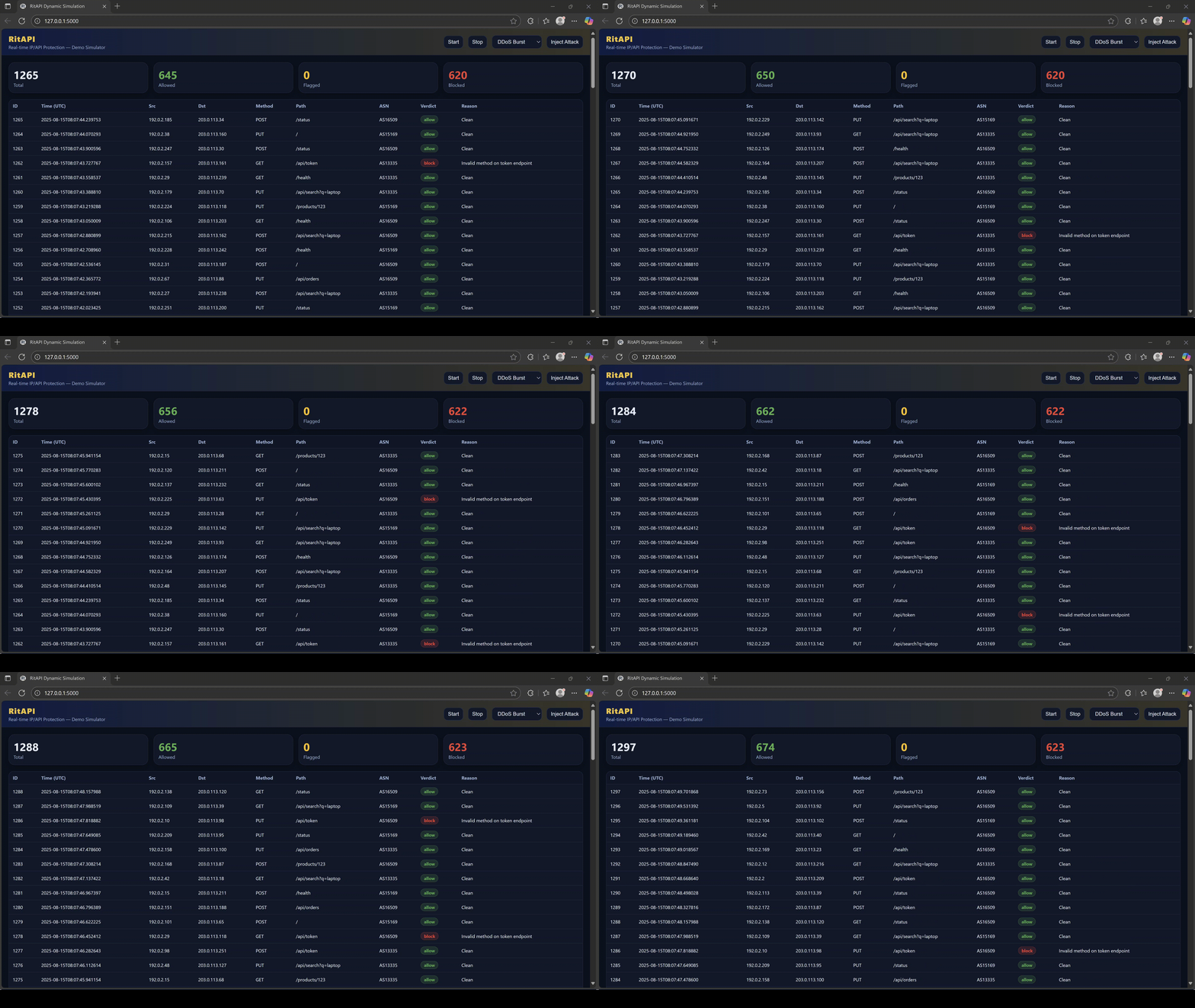
If firewalls guard the outside, RitAPI guards the API itself the structure, the logic, the behavior, and the data relationships. That’s why RitAPI blocks attacks that firewalls never even notice.
Below is how RitAPI does it.
1. Deep API Schema & Payload Validation
RitAPI automatically maps your entire API based on:
- OpenAPI/Swagger definitions
- parameter types
- allowed fields
- payload rules
This allows RitAPI to block:
- tampered payloads
- unexpected fields
- malicious input hidden in “valid-looking” JSON
Firewalls can’t do this because they don’t understand API context.
2. Behavior & Anomaly Detection
RitAPI continuously analyzes behavior across:
- users
- tokens
- IP addresses
- endpoints
It identifies threats like:
- “slow and low” API scraping
- sudden request spikes
- suspicious or impossible user behaviors
If a user normally sends 20 requests per hour and suddenly sends 10,000 per minute, RitAPI stops it instantly.
3. Advanced, Resource-Level Authorization Checks
RitAPI doesn’t just check whether a token is valid it checks whether the token has the right to access that specific resource.
It validates:
- ownership
- identity relationships
- whether the access makes sense in context
This stops:
- IDOR (Insecure Direct Object Reference)
- privilege escalation
- cross-user data exposure
Again, something firewalls simply cannot do.
4. Smart, Granular Rate Limiting
Instead of global throttling, RitAPI applies rate limits at the level of:
- endpoint
- token
- action
- usage pattern
This precision makes it far more effective against:
- brute-force attempts
- enumeration
- scraping
5. Real-Time Bot Detection & Blocking
RitAPI includes:
- bot fingerprinting
- device profiling
- pattern analysis
This helps it distinguish:
- genuine user traffic
- automated bot attacks
- stealthy low-volume attacks that mimic humans
These are exactly the attacks that routinely slip through firewalls.
6. Full API Visibility, Including Shadow & Zombie APIs
RitAPI discovers and maps:
- undocumented APIs
- forgotten APIs
- deprecated endpoints still active
These “shadow APIs” are a major cause of breaches and a firewall will never know they exist.
Why RitAPI Succeeds Where Firewalls Fail
| Capability | Firewall | RitAPI |
|---|---|---|
| Signature-based detection | ✔️ | ✔️ |
| API context awareness | ❌ | ✔️ |
| Business logic protection | ❌ | ✔️ |
| Resource-level authorization checks | ❌ | ✔️ |
| Schema & payload validation | ❌ | ✔️ |
| Advanced bot detection | ⚠️ | ✔️ |
| Preventing parameter abuse | ❌ | ✔️ |
Firewalls guard the perimeter.
RitAPI guards the logic, data, and behavior inside the API.
They complement one another but RitAPI protects the parts the firewall cannot see.
Conclusion
Modern API attacks aren’t simple network threats they target logic, authorization flows, and the structure of your application. This is why so many API attacks pass straight through firewalls.
By validating schema, enforcing authorization deeply, analyzing behavior, and understanding API context, RitAPI provides the layer of protection that firewalls were never built to deliver.
#APISecurity #CyberSecurity #FirewallBypass #APIProtection #RitAPI #ZeroTrustAPI #APIAttacks #ApplicationSecurity #DataProtection #ThreatPrevention